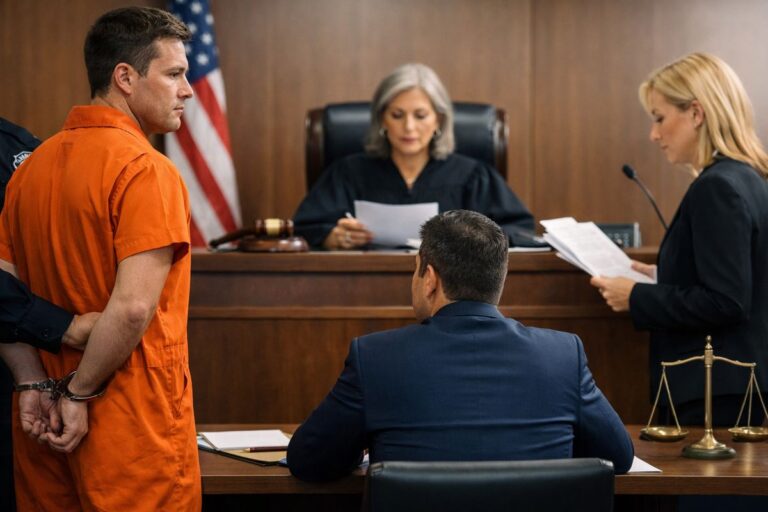
Your Rights During an Arrest: What Police Can’t Ignore

Arrest rights are the constitutional protections that limit what police can do to you during a stop, detention, arrest, search, questioning, booking, and your first steps into court. That matters because police contact is common, and the stakes rise fast once handcuffs, questions, or a search enter the picture. This guide breaks down what police cannot ignore, what your arrest rights actually cover, and the exact words you should use when pressure is high.
What Your Arrest Rights Actually Cover
A 2022 Bureau of Justice Statistics report on police-public contact found that millions of people in the United States have face-to-face encounters with police each year, and a meaningful share of those encounters involve searches, force, or arrest. The point is simple: this is not rare, and knowing your arrest rights before you need them changes how you respond under stress.
Your rights come primarily from the Fourth, Fifth, Sixth, Eighth, and Fourteenth Amendments to the U.S. Constitution. In plain English, those rights protect you from unreasonable searches and seizures, forced self-incrimination, denial of counsel, excessive bail, and unfair procedures. Those protections do not begin only after formal charges appear on paper. They apply across the whole timeline, from the moment police stop you, detain you, question you, search you, arrest you, book you, and bring you before a judge.
What this means in practice: do not treat an arrest as one single moment. It is a chain of moments, and each one has different rules. The move that works is knowing which rights apply at each stage, then using clear language instead of arguing.

When an Encounter Becomes a Stop, Detention, or Arrest
A 2024 report from the National Center for State Courts emphasized a basic reality of criminal procedure: outcomes often turn on labels such as encounter, stop, detention, and arrest because each label changes the level of justification police need. That sounds technical, but the simplest version of this is easy to grasp. Not every interaction with police is the same.
A casual encounter is the least restrictive category. Police can approach you, ask questions, and try to talk. If you are truly free to walk away, it is not yet a detention or arrest. A detention is more serious. Your freedom is restrained for a limited time while police investigate. An arrest is the highest level of restraint. At that point, police are asserting legal custody over you.
Why does this distinction matter? Because it affects whether you can leave, how long police can hold you, what kind of search is allowed, and whether Miranda rules apply. Courts usually ask whether a reasonable person in your position would feel free to leave. That standard is objective. It does not depend only on what police say. It also depends on the setting, the tone, the number of officers, the display of weapons, physical touching, and whether your movement is blocked.
What this means in practice: identify the stage early. That determines your next sentence.
The simplest test: are you free to leave?
A 2023 American Bar Association public legal education review stressed that one of the most effective self-protective habits during police contact is asking for status clearly and early. That one question cuts through confusion fast.
Say, “Am I free to leave?” If the answer is yes, leave calmly and say nothing more. If the answer is no, you now know you are being detained or arrested, which means every word after that matters more. If police refuse to answer, or physically prevent you from leaving, treat the encounter as a detention and act accordingly.
Here’s how to use it: ask the question once, in a calm voice, without sarcasm and without moving suddenly. That creates clarity for you, and it matters later because it shows you did not voluntarily stay for questioning.
Detention is not the same as arrest
A 2023 legal analysis by the Federal Judicial Center explained the core difference between an investigative stop and an arrest: a Terry stop is temporary and limited, while an arrest involves full custody based on probable cause. That difference is not cosmetic. Police need legal justification at each stage, and the justification must match the level of intrusion.
During a Terry stop, police can briefly detain you to investigate suspected criminal activity. The duration must stay tied to that purpose. The scope must stay narrow. A formal arrest allows far more control, including transport, booking, and a full search incident to arrest. If a stop drags on too long or becomes too intrusive without stronger justification, the legality changes.
The practical takeaway is blunt: do not assume a temporary stop is harmless, but do not assume every stop is a lawful arrest either. Ask if you are free to leave. If not, stop explaining yourself and start protecting your rights.
The Legal Standard Police Need Before Arresting You
A 2023 Congressional Research Service overview of Fourth Amendment law described probable cause as facts and circumstances strong enough to justify a reasonable belief that a crime has been committed and that you committed it. That is more than a hunch. It is also less than proof beyond a reasonable doubt.
Police do not need to prove the case on the street. Arrest is not conviction. But police do need a lawful basis grounded in observable facts, witness statements, evidence, admissions, records, or other reliable information. An arrest unsupported by probable cause violates the Fourth Amendment, even if police sound confident in the moment.
What this means in practice: roadside arguments do not fix a bad arrest. Court does. The move that works is preserving your challenge for later and not feeding the case with extra statements now. If your arrest leads to charges, understanding when criminal allegations get thrown out becomes far more useful than arguing facts in handcuffs.
Arrests with a warrant
A 2024 Office of Justice Programs training reference defined an arrest warrant as a court-issued order authorizing police to arrest a named person based on a judicial finding of probable cause. A warrant is not just paperwork. It is prior judicial approval.
If police arrest you on a warrant, you can ask what charge supports the arrest. That is a fair and direct question. Police do not have to hand you the physical warrant at every moment of the encounter, especially on the street, but the arrest still has to match lawful authority. The name, the offense, and the jurisdiction all matter.
Here’s how to use it: ask, “What am I being arrested for?” Then stop there. Do not start defending yourself on the spot.
Arrests without a warrant
A 2023 Department of Justice legal reference explained that warrantless arrests are often lawful when police have probable cause based on what happened in front of them or based on reliable information already developed during an investigation. This is common. Police do not need a warrant for every arrest.
If an officer sees an assault, drunk driving, shoplifting, or another offense unfold, an on-the-spot arrest is often lawful. The same is true when police arrive with enough facts from witnesses, surveillance, records, or other evidence establishing probable cause. The absence of a warrant does not automatically make the arrest invalid.
The practical takeaway is simple: “Do you have a warrant?” is not a magic defense. If police say no, your rights still matter, but the arrest can still be lawful.
What Police Must Tell You During an Arrest
A 2023 National Institute of Justice training summary noted that officers are generally expected to communicate the basis for detention or arrest once custody is clear, because notice supports due process and the later court process. That does not mean police have to give you a courtroom speech on the sidewalk.
You are entitled to understand the basic reason you are being stopped or arrested. That notice matters because it affects bail, charging, defense strategy, and what your lawyer needs to address first. But arrest law is full of myths, and one of the biggest is the idea that police must explain every detail immediately or the arrest vanishes. That is false.
What this means in practice: ask for the reason once, then stop pressing. The street is not discovery. It is not trial. It is not the place where police have to lay out the whole case.
Your right to know the reason for the arrest
A 2024 public defense resource from the Legal Aid community emphasized that notice of the offense is a basic fairness principle. If you are taken into custody, you should be told what offense is at issue, at least in a general way.
That matters because the accusation shapes everything that follows, from whether you are held to what conditions a judge sets. If you later review records and the stated basis keeps shifting, that inconsistency can matter to your defense. The reason is not just informational. It can become evidentiary.
The action here is straightforward: ask, “What is the charge?” Then say nothing about the facts.
What police do not have to explain on the spot
A 2023 defense practice guide published by the National Association of Criminal Defense Lawyers explained that police do not have to debate evidence, reveal confidential informants, summarize the investigation, or answer every question during an arrest. Silence from police does not erase your rights.
Police also do not have to argue with your version of events at roadside. If police choose not to answer, do not fill the silence. That silence often tempts people into volunteering facts, timelines, apologies, and explanations. That is exactly where damage happens.
What this means in practice: once you know you are under arrest, information only flows one way unless you stop it.
Miranda Rights: What They Mean and When They Apply
A 2023 Cornell Legal Information Institute summary of Miranda doctrine states the rule clearly: police must advise you of your rights before custodial interrogation if prosecutors want to use your statements in their case-in-chief. Two triggers matter, and both must be present. You must be in custody, and police must be interrogating you.
This is one of the most misunderstood parts of arrest rights. Miranda warnings are not required every time handcuffs appear. They are not required before every question in every setting. The warning is tied to custodial interrogation, not to the bare fact of arrest itself.
What this means in practice: do not wait for police to read you rights before protecting yourself. Protect yourself immediately by invoking your rights clearly. For a deeper breakdown of how that protection works, see what staying silent actually protects.
What “in custody” means
A 2024 American Law Institute educational summary described custody as a setting where your freedom is restrained to the degree associated with formal arrest. In plain English, you are not free to leave, and the environment carries the pressure of official control.
A roadside traffic stop is serious, but it is not always custody for Miranda purposes. Brief questioning during a temporary stop often falls outside full Miranda custody. Once you are handcuffed, placed in a patrol car, taken to a station, or otherwise held in a way that feels like formal arrest, custody is much easier to establish.
Here’s the practical point: if you know you cannot leave, act as if every answer matters, because it does.
What counts as interrogation
A 2023 Federal Law Enforcement Training Centers reference explained that interrogation includes direct questioning and also words or actions police should know are reasonably likely to produce an incriminating response. So interrogation is not limited to obvious questions like, “Did you do it?”
Comments designed to draw you out can count. So can casual-seeming conversation after arrest. “Help me understand what happened,” “Now is your chance to explain,” and “This goes easier if you cooperate” are not harmless lines. They are often efforts to get statements.
The takeaway: do not mistake a relaxed tone for a safe conversation. After arrest, small talk is evidence bait.
What happens if police never read Miranda rights
A 2024 Brennan Center educational explainer made the main point plainly: failure to give Miranda warnings does not automatically erase charges or force your release. The usual consequence is about statements, not the whole case.
If police get statements from custodial interrogation without proper warnings, the prosecution can face limits on using those statements at trial. But physical evidence, witness testimony, surveillance, and other independent evidence can still support the case. This is why “You never read me my rights” is not a get-out-of-jail card.
What this means in practice: do not rely on police mistakes to save you. Rely on disciplined silence.

Your Right to Remain Silent , and How to Use It Correctly
A 2023 National Legal Aid and Defender Association training resource emphasized a point that surprises many people: your Fifth Amendment protection works best when you invoke it clearly. Silence alone creates disputes. Clear words create a record.
The strongest simple phrase is: “I am invoking my right to remain silent.” That wording is direct, plain, and hard to misunderstand. After that, stop talking about the facts, the timeline, the people involved, the objects involved, and your explanations.
What this means in practice: silence is not passive. It is an active legal choice, and you need to say it before you live it.
Why talking rarely helps you
A 2024 Innocence Project public education resource warned that innocent people often talk because innocence creates false confidence. The logic feels natural: if you did nothing wrong, the truth should clear things up. Real life works differently.
Statements get shortened, misheard, taken out of context, and compared against body camera, phone data, witness timelines, and later memory. Stress ruins precision. Even small inconsistencies can be framed as deception. If your words later intersect with charging decisions, the difference between a lesser offense and a serious charge can shape the whole case.
The practical takeaway is firm: innocence is not a reason to talk. It is a reason to protect your accuracy by saying less.
The move that works: invoke, then stop talking
A 2023 public defender training module found that the clearest post-invocation behavior is also the safest one: invoke your right, then stop volunteering anything. If you keep talking after invoking, you create ambiguity that weakens the protection.
Use this script: “I am invoking my right to remain silent.” Then say nothing about the incident. If police keep asking, repeat the same sentence. Do not decorate it. Do not explain why. Do not add “but” and then tell your story.
Here’s how to use it: think of the phrase as a door. Once you close it, do not reopen it yourself.
Your Right to a Lawyer During Questioning
A 2024 Sixth Amendment Center publication stressed that access to counsel is one of the strongest protections in the criminal process because legal advice changes how every later decision gets made. During custodial questioning, the practical power of that right is immediate. Once you clearly ask for a lawyer, police must stop custodial interrogation unless questioning later resumes under lawful rules.
This is where many people fail themselves. Instead of making a clear request, they say, “Do you think I need a lawyer?” or “Maybe I should talk to someone.” That language is weak. It invites more conversation. It does not protect you the way a direct request does.
What this means in practice: ask for a lawyer in one clean sentence, then stop.
How to request a lawyer in a way police cannot ignore
A 2023 American Bar Association criminal justice explainer emphasized that clear and unambiguous wording matters. The best script is simple: “I want a lawyer. I will not answer questions without a lawyer.”
That sentence does two jobs. It requests counsel, and it shuts down questioning. It does not ask permission. It does not sound uncertain. That matters because courts look closely at exact wording when disputes arise over whether you invoked your rights.
The move that works is memorization. Under stress, you do not rise to the moment. You fall to your preparation. If you later need help choosing representation, understanding how to evaluate defense counsel gives you a better starting point than picking the first name you see.
What happens after you ask for a lawyer
A 2024 National Association for Public Defense resource explained that invoking counsel changes interrogation rules, not the fact of custody itself. Police can still book you, fingerprint you, photograph you, transport you, and ask routine administrative questions.
What police cannot do freely is continue custodial interrogation as if your request never happened. That is the line. Booking goes on. Investigative questioning stops. Knowing that difference helps you avoid a common mistake, answering offense-related questions just because the process continues moving.
The practical takeaway: do not confuse movement with obligation. Processing is mandatory. Conversation is not.
Searches During an Arrest: What Police Can and Cannot Search
A 2023 Congressional Research Service review of search law explained that arrest-related searches fall into categories, and each category has its own rule. That matters because people often hear one true rule and wrongly apply it everywhere.
The Fourth Amendment protects against unreasonable searches, but not every search requires a warrant in the same way. A pat-down during a stop, a search of your pockets after arrest, a vehicle search, and a search of your phone are legally different events. If you blur them together, you lose track of where your strongest protections are.
What this means in practice: never assume police authority over your body automatically extends to your car, your bag, or your phone. Different container, different rule.
Pat-downs during a stop
A 2024 training summary from the Federal Judicial Center described a frisk as a limited pat-down for weapons when an officer has reason to believe you are armed and dangerous. That is the lawful purpose. Officer safety.
A frisk is not a free pass to rummage through every pocket, unzip every bag, or inspect every item just because you were stopped. The search must stay tied to weapons detection unless other lawful grounds arise. If an object immediately feels like a weapon, police can act on that. But a frisk is supposed to stay narrow.
Here’s how to use this: do not physically interfere, but do not consent. Say, “I do not consent to any search,” and keep your hands visible.
Searches incident to arrest
A 2023 Department of Justice reference on arrest procedure explained that after a lawful arrest, police can search your person and the area within your immediate reach. The reasons are officer safety and preservation of evidence.
That means pockets, clothing, containers on your person, and objects you can reach at the time of arrest are often searchable without a separate warrant. Once the arrest is lawful, this authority is broad, though not unlimited. The legality of the arrest itself still matters. If the arrest fails, the search tied to it can fail too.
The practical takeaway is direct: once police lawfully arrest you, expect a search of your person. Save the legal challenge for court, not the sidewalk.
Vehicle searches
A 2024 National Highway Traffic Safety Administration enforcement guide explained that car searches follow several different rules depending on the basis for the search. Police can search with your consent. Police can search if probable cause supports the belief that evidence or contraband is in the car. Police can seize items in plain view. Police can conduct inventory procedures after lawful impound. Searches tied to arrest have narrower rules than many people assume.
If you are arrested near a car, that does not automatically give police unlimited power to search every part of it. The basis matters. So does timing. So does your access to the vehicle. This comes up often in impaired-driving cases, and the process after arrest can unfold quickly, especially if you are trying to understand what the DUI custody process looks like.
The action here is simple: do not consent to a vehicle search, and do not argue physically if police search anyway.
Phone searches require special rules
A 2023 summary from the Legal Information Institute, discussing modern digital privacy doctrine, emphasized that cell phones receive stronger protection because of the enormous amount of personal information inside them. A phone is not just another object in your pocket. It is a map of your life.
Police can generally seize your phone during arrest, but searching its digital contents usually requires a warrant. Texts, photos, app data, search history, location information, and cloud-connected records sit behind stronger constitutional protection than physical items carried on your body.
What this means in practice: do not unlock your phone, hand over passwords, or consent to a phone search. The move that works is simple refusal and silence.

Consent: The Right You Lose When You Say “Yes”
A 2024 American Civil Liberties Union public rights guide put it plainly: police ask for consent because consent changes the legal analysis fast. If you say yes, a later challenge gets much harder.
You do not have to consent to a search in most situations. That includes your bag, your pockets in many stop contexts, your car, your phone, and your home unless police already have lawful authority that does not depend on your permission. The problem is that many people say yes out of nerves, politeness, or a mistaken belief that refusal makes guilt look obvious.
What this means in practice: refusal is a legal position, not an insult. Use it.
How to refuse consent without escalating
A 2023 public defender education guide advised using calm, verbal, nonphysical refusal. The best script is: “I do not consent to any search.”
That sentence is clean. It does not invite debate. It does not challenge the officer physically. It preserves your objection for later. If police search anyway, do not block, pull away, grab objects, or shut doors on hands. Physical resistance creates immediate risk and separate charges.
The practical step is memorization. Practice the sentence until it sounds normal in your mouth.
Why consent matters later in court
A 2024 National Association of Criminal Defense Lawyers explainer noted that courts often treat consent as powerful because it can validate a search that otherwise would have required more justification. Once consent enters the record, litigation gets harder.
Pressure in the moment is real, but vague pressure does not always undo apparent consent later. That is why your wording matters now, not later. A calm refusal gives your lawyer something useful to work with. A nervous “sure, I guess” does the opposite.
The takeaway: consent is easy to give away and hard to take back.
Identification, Basic Booking Questions, and What You Still Do Not Have to Answer
A 2023 National Conference of State Legislatures overview showed that identification rules vary by context and by state. That is why confusion is common. The law draws lines between identifying yourself, providing routine booking information, and answering investigative questions.
During a traffic stop, license, registration, and proof of insurance rules are one category. During a stop-and-identify situation, state law controls whether you must state your name under specific conditions. After arrest, booking staff can ask routine biographical questions needed for administration. None of that means you must explain the alleged offense.
What this means in practice: separate identity questions from accusation questions. One often requires compliance. The other calls for silence.
When you must identify yourself
A 2024 state law survey from the Legal Information Institute summarized the practical split. If you are driving, you are generally required to provide license and related documents. If state law includes a lawful stop-and-identify rule, you can be required to provide identifying information during a valid stop. After arrest, booking identity information is standard.
The key is not over-answering. If police ask for your name, address, date of birth, or routine identifying details during lawful booking, give that information. If police slide from identity into “Where were you earlier?” or “Whose drugs are these?” the category has changed.
The action: comply with lawful identification requirements, then invoke your right to remain silent for offense-related questions.
Booking questions versus investigative questions
A 2023 defender training manual explained that routine booking questions are treated differently because they are administrative, not aimed at proving the crime. Name, date of birth, address, height, weight, emergency contact, and medical screening basics usually fit here.
Investigative questions seek evidence. Why were you there, what did you drink, who called you, who owns the gun, where were you coming from, why did you run, and similar questions are not harmless admin chatter. Once questioning touches the alleged offense, your answer can become evidence.
What this means in practice: answer biographical booking questions briefly and accurately. For offense questions, return to your script.
If Police Use Force, Restraints, or Property Seizure
A 2024 Department of Justice use-of-force training summary explained that the constitutional question is objective reasonableness under the circumstances. That is the legal baseline. Force is not automatically illegal because it feels rough or frightening. But force is unlawful when it exceeds what the situation reasonably required.
Police can use force to secure an arrest, control movement, protect safety, and prevent escape. Police cannot use objectively unreasonable force just because you are under arrest. The same general principle applies to destruction or seizure of property. Police can seize property tied to lawful objectives, but not destroy property unnecessarily without legal consequence.
What this means in practice: in the moment, focus on survival, not argument. After release, focus on evidence.
Excessive force is not the same as any force
A 2023 force-analysis guide from the Police Executive Research Forum explained the distinction clearly. Handcuffing, physical guidance, and necessary restraint can be lawful parts of arrest. Slamming, striking, choking, or using weapons without reasonable justification can cross the line.
The law does not judge force with perfect hindsight from a quiet room. It judges force against the facts police faced at the time. But that standard still has teeth. If force exceeded the need, your rights were violated even if the arrest itself was lawful.
The practical takeaway is blunt: do not resist physically in hopes of “making it clear” the force is wrong. That raises danger instantly.
The action after release: document everything immediately
A 2024 civil rights litigation resource from the ABA advised immediate documentation because memory fades and visible injuries change fast. What this means in practice is simple. Write down the time, place, officer names, badge numbers, patrol car numbers, witnesses, exact words used, every injury, every pain point, medical treatment, photos, torn clothing, and property damage as soon as you are safe.
Medical care matters for health, but it also creates records. Photographs matter because bruises, swelling, and cuts evolve. Witness names matter because bystanders disappear. The move that works is speed. If court proceedings follow, those records can matter as much as your memory.
Your Rights if You Are Under 18 or Arrested as a Noncitizen
A 2023 report from the National Juvenile Defender Center and immigration-focused public defender materials made the same point from different directions: some arrests carry added vulnerability and added consequences. Youth are more susceptible to pressure and quick waiver. Noncitizens face consequences that extend beyond the criminal courtroom into detention, status, travel, and removal.
That means basic arrest rights still apply, but the practical danger is higher. A fast answer that seems harmless can trigger long-term damage.
What this means in practice: if you are under 18 or not a U.S. citizen, the move that works is even simpler than usual. Ask for a lawyer immediately and stop answering substantive questions.
If you are under 18
A 2024 National Juvenile Defender Center educational summary explained that young people are more likely to comply with authority, less likely to grasp long-term consequences, and more likely to make damaging statements under stress. That is exactly why extra caution matters.
If you are under 18, do not assume a police officer is “just trying to help” by asking you to explain. Do not waive rights casually. Ask to speak with a parent, guardian, or lawyer, but do not rely on a parent alone as legal protection during questioning. A lawyer matters most.
The practical step: say, “I want a lawyer and I do not want to answer questions.”
If you are not a U.S. citizen
A 2023 American Immigration Council public education resource explained that arrest and plea decisions can affect immigration status, admissibility, detention, travel, work authorization, and removal proceedings. Even a case that looks minor in criminal court can carry serious immigration consequences.
Do not discuss immigration status beyond required identifying information without legal advice. Do not guess, over-explain, or try to reassure officers with details about entry, documents, family, or prior history. The criminal case and the immigration consequences can connect fast.
The move that works is direct: ask for a lawyer immediately, then say nothing about the facts or your status beyond basic identification.
Bail, Phone Calls, and What Happens After Booking
A 2024 Bureau of Justice Assistance booking-process overview described the first custody period as administrative but high consequence. Booking, fingerprinting, photographs, property inventory, holding, bail review, and first appearance all happen early, often before you have fully absorbed what is happening.
Your rights continue after arrest. The setting changes, but the need for discipline does not. Conversations in holding areas, on recorded jail phones, and during transport can still harm you. Booking is not the safe zone where the case pauses.
What this means in practice: focus on contacting legal help, understanding your release conditions, and saying as little as possible about the facts.
Your right to contact a lawyer
A 2023 legal aid custody guide emphasized that early legal contact shapes everything from bail arguments to preservation of evidence. After booking, access procedures vary by facility, but your first call should be used strategically.
Do not spend that call explaining your version of events over a line that may be recorded. Use it to reach a lawyer, or a trusted person whose job is to secure a lawyer for you immediately. If the case continues into court, knowing what your first hearing usually looks like helps you understand why those first hours matter.
The action: use your first meaningful communication to get counsel, not to narrate the incident.
Bail and first appearance basics
A 2024 National Center for State Courts primer explained that bail is the mechanism used to decide whether you can be released before trial and on what conditions. The Eighth Amendment bars excessive bail, which means bail cannot be set as punishment before conviction.
Judges often look at the alleged offense, prior record, court appearance history, ties to the community, safety concerns, and risk of flight. Some people are released on recognizance. Some post bail. Some remain in custody pending further proceedings. If you are trying to understand the stage after booking, it helps to know how arraignment unfolds in plain English.
The practical takeaway is simple: the judge deciding release does not need your roadside explanation. Your lawyer needs your silence more than the court needs your story at booking.

Common Myths About Arrest Rights That Get People in Trouble
A 2023 public legal education survey from the Annenberg Public Policy Center found persistent confusion about core constitutional rights, especially during police encounters. That confusion causes real damage because false confidence leads to bad choices.
This section matters because the biggest mistakes rarely come from total ignorance. They come from half-true myths that sound convincing in the moment.
“If police did not read Miranda rights, the case is over”
A 2024 legal education explainer from Cornell corrected this directly. Miranda violations usually affect statements, not the existence of the entire case.
If police fail to warn you before custodial interrogation, your unwarned statements can face exclusion. But charges do not disappear automatically. Physical evidence, witnesses, videos, and other proof still matter. The practical takeaway is to stop relying on TV law.
“If you are innocent, talking helps”
A 2023 Innocence Project educational resource explained why this is one of the most damaging myths in criminal law. Innocence does not protect you from confusion, memory gaps, bad wording, or strategic questioning.
Talking creates material to compare, twist, and misread. Innocence is not a shield against inconsistency. The move that works is silence plus counsel.
“If a search is illegal, you can physically stop it”
A 2024 ACLU rights guide states the correct rule plainly: never physically resist a search, even if you know it is unlawful. Your remedy is verbal non-consent and later legal challenge.
Physical resistance creates danger immediately and can produce separate charges. The winning move is calm refusal, visible hands, and courtroom challenge later.
“Police need a warrant for every arrest”
A 2023 Department of Justice legal overview explained that probable cause can support many warrantless arrests. Crimes committed in an officer’s presence are the obvious example, but not the only one.
The absence of a warrant does not prove the arrest was unlawful. The real question is probable cause. What this means in practice: stop using “Do you have a warrant?” as if it ends the conversation.
What to Do During an Arrest, Step by Step
A 2024 stress-and-memory review from the National Institute of Justice noted that high-pressure encounters degrade recall and decision-making. That is why scripts matter. Under stress, memorized language beats improvised logic.
From first contact through booking, your goals are narrow. Do not resist. Clarify your status. Invoke silence. Request a lawyer. Refuse consent to searches. Do not explain facts. That sequence protects you better than any roadside speech.
If your case later moves toward plea discussions, sentencing exposure, or record consequences, those later decisions depend heavily on what happened in the first hour. Silence early preserves options later, including decisions about when a negotiated resolution makes sense.
The exact phrases to use
A 2023 defender training program found that short, repeatable phrases are easiest to remember and hardest to distort later. Memorize these four:
“Am I free to leave?”
“I am invoking my right to remain silent.”
“I want a lawyer. I will not answer questions without a lawyer.”
“I do not consent to any search.”
Here’s how to use them in order. If police first approach you, ask if you are free to leave. If the answer is no, stop explaining. Invoke your right to remain silent. If questioning continues, ask for a lawyer in the exact words above. If police ask to search, refuse consent calmly. Then keep quiet.

What to Try This Week
A 2024 American Psychological Association stress-response summary explained that rehearsal improves recall under pressure because practiced language returns faster than newly learned ideas. That is exactly why preparation matters here. You do not want to invent your rights in the back of a patrol car.
Save a note in your phone today with the four phrases from this article, then say them out loud until they feel automatic. That one action gives you something reliable to reach for if your arrest rights ever stop being theory and become your reality.
Frequently Asked Questions
Do police have to read you your rights as soon as you are arrested?
No. Miranda warnings are required before custodial interrogation if prosecutors want to use your statements in their case-in-chief. Police do not have to recite Miranda the moment handcuffs go on.
Should you answer basic booking questions after arrest?
Yes, for routine biographical information such as your name, address, and date of birth. No, for questions about the alleged offense. Once questions turn investigative, invoke your right to remain silent and ask for a lawyer.
Can police search your phone after arrest?
Police can usually seize your phone during arrest, but searching its digital contents generally requires a warrant. Do not unlock your phone or consent to a phone search.
What should you say if police ask to search your car or bag?
Say, “I do not consent to any search.” Say it calmly, verbally, and without physical resistance. If police search anyway, challenge it later through a lawyer.
Does asking for a lawyer make you look guilty?
No. Asking for a lawyer is a constitutional right, not an admission. It is the smart move because it stops you from making statements that can be misunderstood or used against you.
Can an illegal arrest or search make charges go away?
Not automatically. A violation can lead to suppression of statements or evidence, and in some cases weaken or defeat the prosecution. But dismissal is not automatic. The legal remedy depends on what police did and how that evidence affected the case.
Speak With Attorney Nathan J. Dineen
Attorney Nathan J. Dineen represents clients facing DUI, OWI, and related criminal charges throughout Wisconsin. His approach combines strategic courtroom advocacy with advanced training in standardized field sobriety testing, drug-recognition evaluation, and the science behind breath, blood, and chemical testing.
Nathan has also presented DUI defense topics to other attorneys and has been recognized by legal organizations for trial advocacy, professional achievement, and work in impaired-driving defense.
A DUI or OWI charge can affect your license, career, reputation, and future. Get experienced legal guidance before making your next decision.
Schedule your confidential consultation with Attorney Nathan J. Dineen today.

About Nate Dineen
Wisconsin legal insights from the DUI Defense WI team.