Felony Sentencing: What Judges Consider and Why

Felony sentencing is the court process that sets the legal punishment after a felony conviction or guilty plea. It matters because the sentence controls custody, supervision, money owed, and the long-term consequences that follow a felony case. The process looks formal because it is. Judges do not pick a number by instinct.
Define felony sentencing
Felony sentencing begins after guilt is established. That can happen through a guilty plea, a no contest plea where allowed, or a trial verdict.
The sentence is the court’s official penalty for the offense. It can include prison, jail, probation, fines, restitution, treatment, community service, or supervision after release.
The key point is timing. Sentencing is not about deciding guilt. That part is over.
Distinguish felony from misdemeanor sentencing
A felony is the more serious class of crime. A misdemeanor is the lower class.
Felony sentencing usually carries greater exposure. The person may face state prison or federal prison. Supervision often lasts longer. Collateral effects also tend to run deeper, including voting limits in some states, firearm restrictions, immigration risk, and barriers to work or housing.
Misdemeanor sentencing can still be serious. It often involves shorter jail terms, lower fines, and shorter probation. A fuller explanation of the line between the two appears in the difference between lower and higher criminal charges.
Mark the point when sentencing happens
Sentencing happens after conviction. That includes a plea or a verdict after trial.
The hearing usually does not happen the same day as the plea or verdict. Courts often set a later date so the parties can gather records, prepare arguments, and review a presentence report if one is required.
Map the felony sentencing process
Most felony sentencing follows a simple sequence. Conviction comes first. Investigation and record gathering come next. The hearing follows. The court then enters a written judgment.
That sequence matters because each stage shapes the result. Facts added late can still affect the sentence if the law allows them and the parties can respond.
Review the presentence investigation
Many courts order a presentence investigation. A probation officer or similar court officer usually prepares it.
The report often includes the offense facts. It may also include prior convictions, school and work history, family background, mental health history, substance use, military service, financial information, and a sentencing recommendation.
Victim information may appear in the report. So may restitution claims and statements about physical, financial, or emotional harm.
The report is not beyond challenge. Defense counsel can object to inaccurate facts, criminal history errors, or unsupported claims. That matters because a small record mistake can change the sentencing range.
Hold the sentencing hearing
The sentencing hearing is the court session where the judge decides the penalty. The prosecutor speaks. Defense counsel speaks. Victims may speak if the law permits. The defendant may also speak. That statement is often called allocution.
The prosecutor argues for a lawful sentence. The defense argues for a different lawful sentence. They may disagree about the facts, the guideline range, the value of mitigation, or the need for prison.
The judge may ask questions. The judge then states the findings and announces the sentence on the record.
In some cases the hearing follows a negotiated plea. That process often begins earlier, during the stage when the parties resolve charges by agreement.
Enter the judgment
After the hearing, the court enters a written judgment. That document is not a formality. It controls the sentence.
The judgment states the offense of conviction and the penalty imposed. It may set custody terms, probation conditions, fines, restitution, court costs, and deadlines for appeal. If the oral ruling and written judgment conflict, the issue can trigger later motion practice or appeal.

Identify the main sources judges use
Judges sentence within a legal framework. Statutes set the basic range. Guidelines may shape the likely range. Appellate cases and court rules define what is lawful procedure.
The sentencing record also matters. That includes the plea agreement, trial record, presentence report, exhibits, victim statements, and arguments made at the hearing.
Apply statutes
Criminal statutes are the starting point. They define the felony class and the authorized punishment.
A statute may set a maximum term. It may also set a minimum term. Some statutes bar probation. Others permit alternatives to prison. Some add fixed years if certain facts are present.
State law and federal law differ. Even two states can treat the same conduct in different ways. The offense labels may look similar, but the sentencing structure may not.
Use sentencing guidelines
Many systems use guidelines or recommended ranges. These can be binding, advisory, or absent.
In a guideline system, the court often calculates an offense level or severity score. Criminal history is then added. The combination produces a recommended range.
Some state systems use grids. Federal court uses the United States Sentencing Guidelines as an advisory framework after the Supreme Court’s decision in United States v. Booker. The guidelines still matter because judges must calculate them correctly before choosing a sentence.
Check case law and court rules
Appellate decisions shape sentencing law. They decide what facts may support enhancements, what procedures must be followed, and when a sentence is illegal or unreasonable.
Court rules also matter. They set deadlines for objections, disclosure of reports, victim notice, and preservation of error for appeal.
Sentencing law can turn on constitutional limits. The Supreme Court held in Apprendi v. New Jersey that facts increasing punishment beyond certain limits may require jury findings, except for prior convictions. Those rules are technical, but they affect real outcomes.
Weigh the offense itself
The offense sits at the center of felony sentencing. A judge looks at what happened, how it happened, and what harm it caused.
Two convictions under the same statute can produce different sentences. The reason is usually the facts.
Measure harm
Harm can be physical, financial, or both. A case involving major injury will usually be treated as more serious than one with no injury.
Property damage also matters. So does the amount of money lost in fraud or theft cases. Courts may also consider broader harm to a community, especially in drug trafficking, public corruption, or large fraud cases.
Victim losses can affect both prison exposure and restitution. In federal fraud, loss amount often changes the guideline level. In state court, it may affect offense grading or aggravation.
Examine intent and conduct
Intent changes blame. Deliberate conduct is treated differently from accidental conduct.
Planning often makes a sentence worse. So can use of force, threats, concealment, repeated acts, or abuse of a position of trust. A theft by an employee with access to company funds is often seen as worse than a spontaneous taking by a stranger because the breach of trust adds weight.
The same logic appears across many charges. For example, the facts that separate one property crime from one involving force against a person often drive a major sentencing difference.
Consider the victim impact
Victim impact statements can influence the court’s view of harm. They may describe injury, loss, fear, cost of treatment, or the practical effects of the offense.
That does not mean victim views control the sentence. The judge must stay within the law. The defense may also challenge unsupported claims or disputed loss amounts.
Victim rights are recognized in many systems. Federal law includes crime victims’ rights in sentencing proceedings. States often have similar provisions.
Review the defendant’s criminal history
Prior record matters in almost every sentencing system. It affects risk assessment, punishment, and often the legal range itself.
A person with no record stands in a different position from a repeat offender. The law often treats those cases differently on purpose.
Count prior convictions
Courts review prior felonies and misdemeanors. Similar prior crimes often matter more than unrelated ones.
Some systems score each conviction. Others focus on number, timing, and seriousness. Older convictions may carry less weight in one jurisdiction and full weight in another. Habitual offender laws can also make old convictions newly important.
Accuracy is a recurring issue. Dates, offense labels, and out-of-state records can be disputed. A mistake in criminal history can shift a range upward.
Check probation, parole, or pending cases
Status at the time of the offense can matter. A person who commits a new felony while on probation, parole, bail, or other supervision often faces harsher treatment.
The same is true when the defendant had a pending case. Courts may view new crime during open supervision as evidence that earlier intervention failed.
That issue often becomes decisive in cases involving suspended sentences or felony probation. A separate explanation of how supervision terms work and what leads to violations gives that topic more detail.
Separate arrests from convictions
Arrest is not conviction. That distinction matters.
A prior arrest does not prove guilt. Judges generally cannot treat an arrest alone as if it were a conviction. Still, background reports may mention prior contacts with law enforcement, pending allegations, or conduct described in police reports. The defense may object to unreliable material.
This is one reason the presentence report gets close review. Unsupported accusations should not silently become sentencing facts.
Assess aggravating factors
Aggravating factors are facts that support a higher sentence within the lawful range. They do not create guilt. They increase blame or risk.
The list changes by statute and jurisdiction. Some factors are written into criminal codes. Others come from guideline rules or case law.
Use of a weapon
Use of a gun, knife, or other weapon often increases punishment. In some systems, simple possession during the offense is enough. In others, the person must display, brandish, fire, or use the weapon.
Some laws add mandatory time for firearms. Federal law includes firearm penalties under 18 U.S.C. § 924(c). States use their own versions.
Weapon findings can change plea strategy and trial strategy. They can also decide probation eligibility.
Vulnerable victim
Crimes against children, older adults, and disabled people often receive harsher treatment. The law treats those victims as more vulnerable to exploitation or harm.
Vulnerability can also arise from circumstance. A sleeping victim, an isolated patient, or a person under custodial care may fall within aggravating rules depending on the statute.
Leadership role or organized conduct
A person who directed others may face a higher sentence than a minor participant. Organized conduct tends to suggest planning and larger scale.
This issue appears in gang cases, fraud rings, drug conspiracies, and theft schemes. Federal guidelines, for example, increase offense levels for organizers or leaders under Guideline § 3B1.1.
Leadership aggravation is about role. It is not limited to the charged offense title.
Obstruction or lack of compliance
Conduct after the offense can still matter. Witness tampering, destruction of evidence, false statements, flight, and repeated failures to appear can increase the sentence.
Courts also notice behavior during the case. Ignoring release conditions, contacting protected persons, or violating no-contact orders can weaken a request for leniency. A separate discussion of what follows when a protective order is broken shows how that issue can expand criminal exposure.

Assess mitigating factors
Mitigating factors are facts that support a lower sentence. They do not erase the conviction.
Mitigation gives the court a fuller picture of the person and the case. It helps explain why the lowest lawful sentence may be enough.
Limited prior record
A clean record matters. A minor record can also matter.
First-time felony offenders often receive more attention to alternatives such as probation, treatment, or a suspended sentence. That does not guarantee leniency. It does place the person in a different category from a repeat offender.
Some statutes expressly favor non-prison outcomes for lower-level first offenses. Others do not.
Acceptance of responsibility
A guilty plea can reduce exposure. Truthful cooperation can also help. Restitution efforts may matter if they are timely and genuine.
Acceptance of responsibility is not the same as giving up all legal rights. A defendant may challenge the guideline calculation, object to facts in a report, or preserve appellate issues.
In federal court, acceptance can reduce the offense level under Guideline § 3E1.1. State systems often use a similar concept without the same formula.
Mental health, addiction, and personal history
Mental illness, developmental limits, trauma, and addiction can affect sentencing. These facts may explain conduct, lower culpability, or support treatment over incarceration.
The same facts can cut the other way. Untreated addiction may increase concern about future risk. A severe mental health history may prompt a court to impose stricter supervision conditions.
Context matters. Records matter more than broad claims. Judges often want treatment records, evaluations, and compliance history.
Support, work, and rehabilitation efforts
Stable work history can help. Family support can help. Program completion before sentencing can help.
Judges often look for signs that change is already underway. Negative tests, counseling attendance, restitution payments, and compliance with release terms are concrete facts. Letters from employers, counselors, or family may reinforce them.
These facts rarely outweigh a severe offense on their own. They can matter a great deal in close cases.
Set the sentence range
Judges work within legal limits. They do not pick any sentence they prefer.
The main job at sentencing is often range calculation. Once the lawful range is set, the court chooses a point within it or decides whether departure is allowed.
Minimum and maximum terms
A statutory maximum is the highest punishment the law permits. A statutory minimum is the lowest term the law requires, if one exists.
Some felonies leave a wide gap between minimum and maximum. Others leave little room. A class of felony may carry, for example, up to 5 years, while another may require at least 10 years.
Wide ranges increase judicial discretion. Narrow ranges reduce it.
Presumptive, standard, and advisory ranges
Many states use presumptive or standard ranges. Those ranges may depend on offense severity and prior record.
Federal court uses an advisory guideline range. The judge must calculate the range and then decide what sentence is sufficient under 18 U.S.C. § 3553(a). That statute directs courts to weigh seriousness, deterrence, protection of the public, and rehabilitation.
An advisory system still influences outcomes. The range anchors the hearing even when the judge chooses a different sentence.
Mandatory minimum sentences
Mandatory minimum laws require at least a set term. The judge may dislike the result and still have to impose it.
Some statutes permit departures below the minimum in narrow circumstances. Examples include substantial assistance motions in federal court or safety valve relief for some drug cases under 18 U.S.C. § 3553(f).
These laws change leverage in plea negotiations. They also explain why two cases with similar facts can produce different outcomes based on charge selection alone.
Explain sentence enhancements
An enhancement is not always a separate charge. It is often a legal addition that raises punishment because specific facts are present.
That point causes confusion. A person may be convicted of one offense but sentenced based on added findings that increase the term.
Prior strike or habitual offender laws
Many states punish repeat felony conduct more harshly through strike laws or habitual offender statutes. A new felony can trigger a longer term because of old convictions.
The details vary sharply. Some systems require prior violent felonies. Others apply to a broader set of crimes. Some raise the sentencing range. Others add a mandatory term or alter parole eligibility.
A prior record that seems remote can return as the central issue if a repeat-offender law applies.
Firearm and injury enhancements
Common enhancements include firearm use and great bodily harm. These can add fixed years or move the sentence into a higher range.
Some statutes require personal use of the weapon. Others apply if any participant used one. Injury enhancements also differ. Minor injury may not qualify. Serious injury often does.
The exact wording of the statute controls. Small factual differences can determine whether the add-on applies.
Hate crime, drug zone, and other special enhancements
Other enhancements cover bias motive, drug sales near schools, crimes in protected locations, domestic violence patterns, gang activity, and abuse of public office.
The key issue is fit. The government must prove facts that match the statute. A label alone is not enough.
That is one reason sentencing disputes can look like mini-trials. The hearing may turn on a narrow fact that carries years of added exposure.
Compare common sentencing outcomes
Prison is only one possible felony sentence. Courts use several forms of punishment, often in combination.
The outcome depends on the offense, the record, and the law of the jurisdiction. A broader review of the penalties that can follow a felony conviction shows how those consequences continue after the hearing.
Prison or jail term
Felony sentences can lead to state prison, federal prison, or local jail. The place depends on the system.
State felonies often go to state prison. Federal felonies go to federal prison. Some lower-level felony sentences are served in county jail in states that use jail-based felony custody for shorter terms or specific offense classes.
Sentence length also matters. So does local law.
Probation
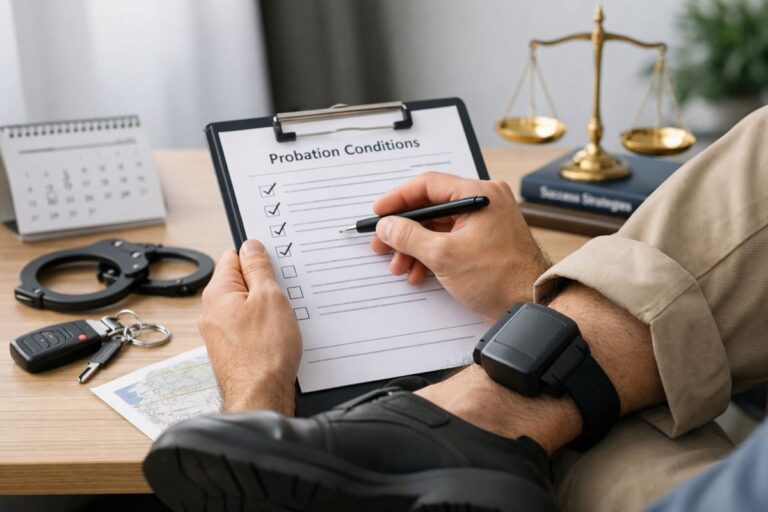
Felony probation allows the person to remain in the community under court supervision. It is not freedom without limits.
Common conditions include reporting, employment rules, treatment, testing, search terms, no-contact orders, travel limits, and payment obligations. A felony probation term may last years.
Probation can be a final sentence. It can also follow a short jail term.
Split sentence or suspended sentence
A split sentence combines custody and supervision. One common version is several months in jail followed by probation.
A suspended sentence means the court imposes a term but pauses all or part of it. If the person complies with conditions, the suspended time may never be served. If the person violates, the court may impose some or all of that time later.
These options are common in state court. They are less common in some federal settings.
Fines, restitution, and fees
Fines punish the offense. Restitution repays victims for measurable loss.
The difference matters. A fine is owed to the state. Restitution is owed to the victim or victims. Fees and court costs are separate and depend on local law.
Restitution can be large in fraud, theft, and injury cases. A person may finish custody and still owe money for years.
Community service, treatment, and special conditions
Courts often add tailored conditions. These may include drug treatment, mental health counseling, batterer intervention, anger management, education programs, curfew, electronic monitoring, or community service.
These conditions can attach to probation, parole, or post-release supervision. Failure to comply can trigger sanctions even if no new crime occurs.
Address probation eligibility and violations
Many felony defendants want to know if prison can be avoided. The answer turns on law and facts, not on hope.
Probation may be available in one felony case and barred in another. The same offense can also produce different results based on criminal history or injury level.
Determine who can get probation
Eligibility depends on the offense, the statute, the record, and the harm caused. Some felonies are probation-eligible. Some are not.
Violence, weapon use, major injury, repeat offender status, and mandatory minimum statutes often reduce or eliminate probation options. Lower-level nonviolent felonies may allow probation more often.
Plea terms also matter. In some cases a negotiated reduction changes probation eligibility. In other cases the charge itself bars it.
Set probation conditions
If probation is granted, the court sets conditions. Some are standard. Others are tied to the offense.
Drug cases may require testing and treatment. Domestic violence cases may require no-contact orders and intervention programs. Theft or fraud cases may require restitution and work requirements.
The sentence does not end when the hearing ends. Probation conditions become the next legal risk.
Respond to probation violations
A violation can start with a report from the probation officer. The court may issue a summons or warrant.
Possible outcomes include a warning, added conditions, a short jail sanction, extension of supervision, or revocation. Revocation means the court ends probation and imposes custody allowed by the original sentence.
Proof standards at a violation hearing are often lower than at a criminal trial. That difference is why probation is valuable but fragile.
Explain multiple counts and consecutive terms
Cases with more than one count can produce large sentence swings. The total sentence may depend less on any single count than on how counts interact.
This is one of the least understood parts of felony sentencing. It is also one of the most important.
Concurrent sentences
Concurrent sentences run at the same time. If a person receives 5 years on count 1 and 3 years on count 2, both concurrent, the total time is 5 years.
Concurrent sentencing is common when counts arise from the same event or when the law permits a single combined punishment approach. It reduces total exposure.
Consecutive sentences
Consecutive sentences run one after the other. A 5-year term followed by a 3-year term becomes 8 years total.
Some laws require consecutive terms for certain offenses or enhancements. In other cases the judge chooses between concurrent and consecutive sentencing based on facts such as separate victims, separate acts, or separate dates.
That choice can matter more than the base term. It often becomes the center of the hearing.
Merge counts and lesser included offenses
Not every count can produce separate punishment. Some counts merge because one is a lesser included offense of another, or because separate punishment would duplicate the same act.
Merger rules prevent double punishment in some circumstances. The exact rule depends on the jurisdiction and the elements of the offenses.
This is a technical area. It can still save years of exposure when it applies.
Cover supervision after custody
Many felony sentences continue after release. Custody may end. Supervision may not.
The terms after release can be strict. Violations can send the person back to jail or prison.
Parole and post-release supervision
Parole is supervised release after prison in systems that still use it. Some states abolished parole for many offenses and replaced it with fixed release structures.
Federal court does not use parole for modern offenses. It uses supervised release after custody. Many states use post-release supervision, mandatory supervision, or similar labels.
The label changes by jurisdiction. The basic idea is the same. The person is out of custody but still under rules.
Conditions of release
Release conditions often include reporting, testing, treatment, work expectations, residence approval, curfew, travel restrictions, and no-contact terms.
These rules can be narrower than ordinary life. A releasee may need permission to move, leave the county, change jobs, or contact certain people.
The severity of the conditions often reflects the offense and the risk assessment used by the agency.
Violations after release
If release conditions are broken, the supervising agency may respond with sanctions. Those can include warning measures, stricter terms, treatment orders, electronic monitoring, or arrest.
A formal hearing may follow. The person may be returned to custody for part of the remaining term or for a fixed sanction under the governing law.
Release violations are not always new crimes. Missing treatment or using alcohol may be enough.
Show state and federal differences
Felony sentencing is not one national system. State courts and federal courts use different statutes, different structures, and different terminology.
That is why online comparisons often confuse people. Similar conduct can produce different outcomes depending on where the case is filed.
State sentencing systems
State systems often use felony classes, such as Class A through Class E, or numbered degrees. Each class carries a statutory range.
Some states use determinate sentencing. Others use presumptive ranges, parole eligibility rules, or probation-heavy outcomes for lower-level felonies. County jail sentences for some felonies are common in certain states.
The variation is sharp. A drug offense, theft offense, or assault offense may be treated one way in one state and another way elsewhere. The same is true in offenses such as cases that begin as low-value theft but can rise into felony territory.
Federal sentencing
Federal sentencing begins with the statute and the advisory guidelines. The court calculates the offense level and criminal history category.
The judge then applies the factors in 18 U.S.C. § 3553(a). Supervised release often follows custody. Mandatory minimums play a large role in some federal drug and firearm cases.
Federal sentences also tend to depend on document-heavy findings. Loss amount, role, number of victims, drug weight, and obstruction can move the range sharply.
Why two similar cases can end differently
Two cases can look similar on the surface and still end far apart. Jurisdiction is one reason.
Charge selection is another. Plea terms matter. Criminal history matters. Local statutes matter. So do mandatory minimums, victim injury, and enhancements.
The result is not random. It reflects different legal frameworks applied to different records.
Explain the role of plea deals
Many felony sentences are shaped before the sentencing hearing begins. Plea bargaining often sets the outer limits.
That does not mean the judge has no role. It means the field of options may narrow long before sentencing day.
Charge bargaining
In charge bargaining, the prosecutor agrees to reduce or dismiss counts in exchange for a plea. That can lower sentencing exposure by removing enhancements, reducing offense grade, or narrowing the factual basis.
A charge can also be dismissed for other reasons. Those situations differ from a negotiated plea and are explained in the circumstances that can lead prosecutors or courts to drop a case.
Charge bargaining is common because it resolves risk for both sides. It also saves trial time.
Sentence recommendations
Some plea agreements include a joint recommendation. Others cap exposure. Others leave sentencing open.
In an open plea, the defendant pleads guilty without a firm sentencing agreement. The judge then decides within the lawful range. In a capped plea, the sentence cannot exceed a stated limit. In a fixed plea, the agreement may specify the exact sentence if local rules allow it.
Judges may accept, reject, or weigh these agreements depending on the jurisdiction. The written plea terms matter.
Trial penalty debate
A recurring debate concerns whether sentences after trial are higher than plea outcomes. The phrase often used is trial penalty.
The concern arises because a defendant who rejects a plea and goes to trial may lose acceptance credit, face reinstated counts, or receive a sentence based on the full proven conduct. Courts and scholars describe the issue in procedural terms. The debate is about structure, not only about motive.
Correct common myths about felony sentencing
Public discussion of felony sentencing often strips away the legal structure. That creates myths.
A few corrections make the process easier to understand.
Judges can sentence any way they want
Judges have discretion. They do not have unlimited discretion.
Statutes, mandatory minimums, enhancements, procedural rules, constitutional limits, and appellate review all constrain the sentence. A sentence outside those limits can be reversed or corrected.
A first felony always means prison
A first felony does not always lead to prison. Some first-time offenders receive probation, a split sentence, local jail time, or a suspended term.
The offense still controls. A first-time person convicted of a serious violent felony may still face prison with little room for leniency.
Mitigating factors erase a conviction
Mitigation affects punishment. It does not undo guilt.
A conviction remains unless it is later reversed, vacated, dismissed through lawful process, or changed by post-conviction relief. Sentencing is not acquittal.
Good behavior before sentencing guarantees leniency
Positive conduct before sentencing can help. It never guarantees a lower sentence.
A judge may credit treatment attendance, work, restitution, and compliance. The judge must still account for the offense facts, the legal range, and public safety concerns.
Answer practical questions after sentencing
The case often continues after the hearing. Deadlines begin to run. Records become important.
Many later disputes depend on what was said in court and what the written judgment states.
Can a felony sentence be appealed
A felony sentence can often be appealed, but not on every ground. Common arguments include legal error, unlawful conditions, guideline miscalculation, abuse of discretion, or a sentence above the statutory limit.
Deadlines are short. Some plea agreements waive part of the right to appeal. Preservation rules also matter. An issue not raised below may be harder to win later.
Can a sentence be reduced later
Some sentences can be modified. The path depends on the jurisdiction.
Possible routes include rule-based correction of clerical or legal error, resentencing after appellate reversal, statutory sentence modification, compassionate release, and relief based on retroactive law changes. Availability is narrow in many systems.
Can a felony be expunged or sealed
Relief after conviction varies widely. Some felonies can be sealed. Some can be expunged. Many cannot.
Sealing and expungement are not the same. Restoration of civil rights is a separate issue. A more direct explanation appears in the rules that govern whether a felony remains part of the public record.
What records matter most
The key records are the judgment, the sentencing transcript, the plea agreement, the presentence report, and any restitution order.
Each serves a different function. The judgment controls the formal sentence. The transcript shows what the judge said. The plea agreement defines what was promised. The presentence report contains background facts and calculations. Accuracy in each record matters because later custody, supervision, and appeal decisions often depend on them.
Frequently Asked Questions
How long does felony sentencing take after a guilty plea or verdict?
It often takes several weeks. The court may need time for a presentence report, victim submissions, criminal history checks, and written sentencing arguments. Some cases move faster. Complex felonies can take longer.
Can a judge ignore a sentencing recommendation from the prosecutor?
Yes, in many cases. A prosecutor’s recommendation is often influential but not binding. The judge must follow the law and may impose a different lawful sentence unless the plea agreement and local rules require a different process.
Does restitution reduce jail or prison time?
Not by itself. Restitution can support mitigation because it shows accountability and effort to repair harm. The court may still impose custody if the offense and the law call for it.
Can a defendant speak at sentencing?
Yes. Most systems allow the defendant to address the court before sentence is imposed. That statement is often called allocution and may cover remorse, personal history, treatment progress, family responsibilities, or plans after sentencing.
What happens if the written judgment does not match what the judge said in court?
The issue should be raised quickly. Courts can correct clerical mistakes, and appellate courts may review material conflicts. The mismatch matters because the written judgment usually guides custody agencies and supervision officers.
Do felony sentences always include probation after prison?
No. Some sentences end after custody. Others include parole, supervised release, or post-release supervision. The result depends on the jurisdiction, the offense, and the sentencing statute.
Speak With Attorney Nathan J. Dineen
Attorney Nathan J. Dineen represents clients facing DUI, OWI, and related criminal charges throughout Wisconsin. His approach combines strategic courtroom advocacy with advanced training in standardized field sobriety testing, drug-recognition evaluation, and the science behind breath, blood, and chemical testing.
Nathan has also presented DUI defense topics to other attorneys and has been recognized by legal organizations for his trial advocacy, professional achievement, and work in impaired-driving defense.
A DUI or OWI charge can affect a person’s license, career, reputation, and future. Get experienced legal guidance before the next decision.
Schedule a confidential consultation with Attorney Nathan J. Dineen today.

About Nate Dineen
Wisconsin legal insights from the DUI Defense WI team.