Criminal Defense Lawyer Cost: What You’ll Actually Pay

Criminal defense lawyer cost in the United States usually starts with a consultation fee or modest misdemeanor flat fee and rises quickly once felony exposure, motion practice, or trial risk enters the case. Across major legal directories, bar resources, and firm pricing pages published through 2026, the pattern is consistent: the final bill depends less on a headline quote than on charge severity, scope of work, and how far the case travels through court.
Criminal Defense Lawyer Cost at a Glance
National pricing summaries reported by legal marketplaces and defense firms place consultations anywhere from free to about $500, hourly rates from roughly $150 to $700, misdemeanor flat fees from about $1,500 to $5,000, and felony retainers from about $5,000 to $25,000 or more. Trial cases routinely exceed those starting numbers, according to published fee discussions from Avvo, LegalMatch, and criminal defense firm websites.
That headline range answers the basic question, but it also hides the real issue. A lawyer handling an early plea on a simple case does not bill the same way as one preparing suppression motions, expert challenges, and jury trial strategy. State-by-state court practice, local filing demands, and prosecutorial posture all shift the total.
Typical Cost Ranges by Fee Model
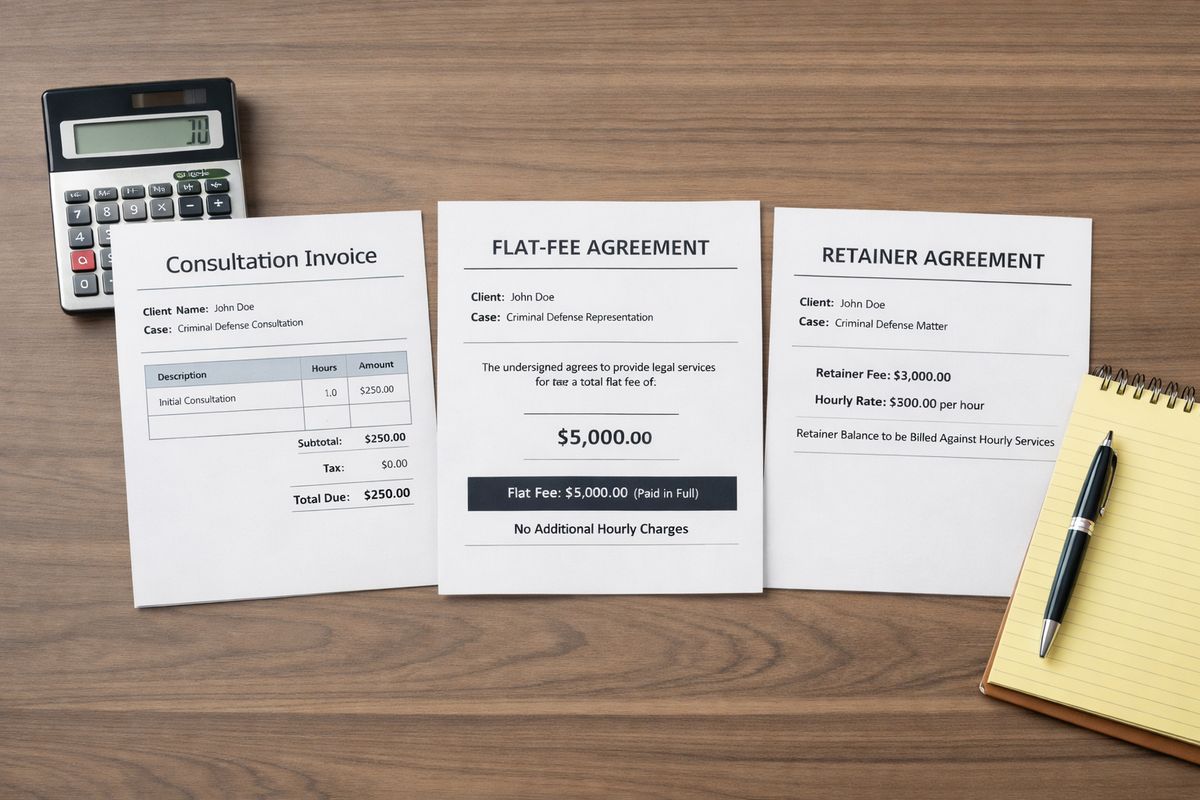
The most common billing models are free or paid consultations, flat fees, hourly billing, and retainers billed against hourly work. Consumer-facing legal pricing pages generally report flat fees for lower-level matters such as first-offense DUI, arraignment coverage, or straightforward misdemeanors. Hourly billing appears more often in contested cases, white-collar matters, and serious felonies.
Retainers function as advance deposits. A client pays a set amount up front, then the lawyer deducts time as the case progresses. According to pricing guides from national legal directories, that structure becomes common once a case involves extensive discovery, multiple hearings, or uncertain trial prospects. Anyone comparing quotes benefits from understanding how defense fees are usually structured before treating one number as the full price.
What Drives Criminal Defense Lawyer Cost
The largest cost drivers appear in a clear order across published legal fee explanations: offense severity, case complexity, stage of proceedings, attorney experience, local market rates, and trial risk. Each factor compounds the others. A felony in a major city with digital evidence, expert disputes, and multiple defendants will cost more than a single-hearing misdemeanor in a rural county.
Balancing that, a higher sticker price does not automatically mean overcharging. A more experienced lawyer often handles charging negotiations, evidentiary issues, and hearing strategy with fewer wasted steps, according to law firm pricing pages and attorney bios. The bill reflects time, judgment, and consequences.
Charge Severity: Misdemeanor vs. Felony
Misdemeanors generally cost less because they involve fewer filings, lighter discovery, and fewer court appearances. Published ranges from defense firms commonly place lower-level misdemeanor representation in the low thousands, while felony defense starts with much larger retainers and escalates from there.
The gap exists for a reason. Felony allegations carry greater exposure, longer records, and more procedural work. Anyone comparing prices should first understand what separates lower-level and felony charges, because the classification usually predicts the fee more accurately than the offense label alone.
Stage of the Case
Costs increase as a case moves deeper into the system. Pre-charge intervention or early negotiations can limit filings and hearings. After arraignment, the price often rises because the lawyer must handle discovery review, motions, conferences, and witness preparation.
That timing issue matters. Court procedure itself creates work, according to criminal defense practitioners who publish fee explanations. A person trying to track the process can review the sequence of an arraignment hearing, which helps explain why legal fees often jump after the first appearance.
Attorney Experience and Local Market
A senior criminal defense lawyer in Milwaukee, Chicago, Los Angeles, or New York generally charges more than a newer attorney in a smaller county. Local overhead, court congestion, and demand all affect rates, according to firm pricing summaries and consumer legal guides.
There is a balancing point, though. Experience affects efficiency as much as prestige. A lawyer who has handled suppression issues, evidentiary challenges, or repeat-offender cases for years often identifies the pressure points faster, which can change total value even when the hourly rate is higher.

Common Fee Structures and What Each One Covers
Published pricing pages show that confusion usually starts with scope, not rate. Two lawyers can quote the same number while covering very different work. One includes routine hearings and plea negotiations. Another charges extra for motions, investigators, and trial preparation.
That is why buyers compare coverage line by line. Price without scope is not a real comparison.
Flat Fees
Flat fees are common for DUIs, misdemeanors, arraignments, probation violations, and plea-based matters with a defined path. The quoted amount usually covers initial case review, routine court appearances, plea discussions, and ordinary communication.
The exclusions matter more than the quote. Trial, expert witnesses, accident reconstruction, investigators, and complex motion work frequently trigger added charges. A low flat fee often buys a narrow lane of representation and nothing beyond it.
Hourly Billing and Retainers
Hourly billing places a price on each unit of attorney time, often in six-minute increments. The client deposits a retainer, and the lawyer bills time against that balance. Once the retainer runs low, replenishment is often required.
This structure becomes expensive quickly in contested cases. Discovery review, body camera footage, forensic records, witness interviews, and repeated court dates consume time fast. Cases involving plea negotiations versus full litigation strategy often diverge sharply in cost because every disputed issue adds billable work.
Extra Costs Beyond Attorney Fees
Published criminal defense cost guides consistently note the same add-ons: investigators, expert witnesses, filing fees, transcript charges, travel, subpoena service, trial exhibits, and bail-related expenses. Those items often sit outside the attorney’s core fee.
That is why the cheapest quote regularly ends up costing more than expected. A client comparing offers should confirm not only legal fees but also who pays for outside experts, accident analysis, toxicology review, and court-record requests.
Cost by Case Type: What People Commonly Pay
Search behavior and legal directory content show that most people look for pricing by offense type. Broad ranges help, but exact promises are unreliable because facts change the workload.
DUI and Traffic-Related Criminal Charges
First-offense DUI or OWI matters are often quoted on a flat-fee basis, commonly in the low to mid-thousands, according to defense firm pricing pages. Repeat offenses, accident allegations, refusal issues, and license-hearing work drive totals higher. Separate administrative work also adds cost, especially when a driver is trying to preserve driving privileges after arrest.
That distinction matters because a DUI case often includes more than one track. Criminal court, administrative suspension issues, and testing challenges all require separate attention. Readers dealing with impaired-driving allegations often first review the steps that follow a DUI arrest to understand why those costs stack up.
Misdemeanor Charges
Shoplifting, simple assault, possession, disorderly conduct, trespass, and similar charges are often handled on flat fees when the case appears likely to resolve early. Published law firm ranges often place these cases between roughly $1,500 and $5,000, with contested matters climbing beyond that.
Not every misdemeanor stays simple. Prior records, immigration concerns, protective orders, or evidentiary disputes can push the matter into hourly billing. A charge that looks minor on paper can create major collateral exposure.
Felony Charges
Felony defense commonly starts with retainers in the mid-thousands and rises into five figures quickly, according to legal directories and criminal defense firms. Drug trafficking, weapons allegations, fraud, felony domestic violence, and violent-crime charges usually require larger retainers because they involve substantial discovery, more hearings, and greater sentencing exposure.
The long-term stakes explain the price. A felony case often carries record consequences, employment barriers, and sentencing issues that extend far past the courtroom. Anyone weighing those stakes should understand how long a felony can follow a person, because that downstream impact often justifies a stronger defense budget.
How to Compare Criminal Defense Lawyers Without Overpaying
Serious buyers compare value, scope, communication, courtroom experience, and billing clarity. A disciplined comparison focuses on what is covered, who handles the hearings, how often updates arrive, and what happens if the case shifts from negotiation to trial.
Fee transparency matters, but so does process. A detailed engagement letter often says more about professionalism than a polished website.
Questions to Ask Before Hiring
The most useful questions are direct: Is the fee flat or hourly? What does it include? Who appears in court? What triggers added charges? What happens if the case goes to trial? How often are invoices or status updates sent?
Those questions reveal scope, staffing, and risk. They also expose whether the lawyer has accounted for likely developments or is quoting a number designed only to secure the retainer.
Warning Signs in Low-Cost Quotes
Unusually low fees often signal limited-scope work, trial exclusions, heavy caseloads, or inexperience. Consumer legal guidance repeatedly warns that a bargain quote can exclude motions, expert review, or meaningful communication.
The balancing perspective is simple: higher fees do not guarantee a better outcome. Some expensive lawyers delegate heavily or bill inefficiently. The better measure is clarity, relevant experience, and confirmed courtroom responsibility. Readers comparing counsel can also review what strong defense representation actually looks like before treating price as a shortcut for quality.
When Paying More Makes Financial Sense
A higher fee often makes financial sense when jail exposure is real, immigration consequences are on the table, a professional license is at risk, or repeat-offender allegations threaten enhanced penalties. The same logic applies to cases that affect child custody, firearm rights, or long-term employability.
In those situations, the legal bill is only one cost category. Lost income, record damage, license suspension, and sentencing consequences often outweigh the difference between two lawyer quotes.
Common Mistakes That Increase Legal Bills
The most common cost mistakes are delay, price-only shopping, and failing to confirm scope in writing. Waiting too long narrows strategic options and creates emergency work. Choosing solely by the cheapest quote often leads to add-on charges later. Ignoring outside expenses leaves the client unprepared when invoices arrive for experts, transcripts, or investigators.
Published legal pricing sources agree on the basic rule: final criminal defense lawyer cost turns on charge severity, billing model, and trial risk. A buyer who confirms scope early, asks how the case will be staffed, and plans for non-attorney expenses usually gets a truer picture of the real bill.
Frequently Asked Questions
How much does a criminal defense lawyer cost for a misdemeanor?
Published pricing pages commonly place misdemeanor defense between about $1,500 and $5,000 for routine cases. Contested evidence, multiple hearings, prior-record issues, or trial preparation increase the total.
Why do felony cases cost so much more?
Felony cases require more time, more discovery review, more court appearances, and more strategic preparation. They also carry higher sentencing exposure, which raises the amount of work expected from defense counsel.
Is a retainer refundable?
A retainer is usually a deposit billed against earned time, not a flat payment that automatically comes back. Any unused portion is typically refundable under the fee agreement and state ethics rules, while earned fees are not.
Do criminal defense lawyers offer flat fees?
Many do, especially for DUIs, arraignments, probation matters, and straightforward misdemeanors. Flat fees are less common once a case becomes document-heavy, expert-driven, or likely to go to trial.
What extra costs should clients expect beyond the lawyer’s fee?
Common added expenses include investigators, expert witnesses, transcript fees, filing costs, subpoena service, travel, and trial exhibits. Those charges are often excluded from the initial quote.
Does hiring a more expensive lawyer guarantee a better result?
No published consumer legal guide makes that claim. Higher fees can reflect experience, local demand, or case complexity, but the better indicator is clear scope, relevant courtroom experience, and direct responsibility for the matter.
Speak With Attorney Nathan J. Dineen
Attorney Nathan J. Dineen represents clients facing DUI, OWI, and related criminal charges throughout Wisconsin. His approach combines strategic courtroom advocacy with advanced training in standardized field sobriety testing, drug-recognition evaluation, and the science behind breath, blood, and chemical testing.
Nathan has also presented DUI defense topics to other attorneys and has been recognized by legal organizations for his trial advocacy, professional achievement, and work in impaired-driving defense.
A DUI or OWI charge can affect a license, career, reputation, and future. Get experienced legal guidance before making the next decision.
Schedule a confidential consultation with Attorney Nathan J. Dineen today.

About Nate Dineen
Wisconsin legal insights from the DUI Defense WI team.